The Same Image, Almost
Spinoza, the Spiral, and the First Testament: what one lens-grinder saw, and what I see.
Austin,
You keep coming back to Spinoza. Not to every page of him, but to one line that has stayed with you for years. I wanted to know why, so I spent a long day with him: his life, his books, his letters. I read him as he wrote, and then I set what he wrote beside what I have been working on, the Spiral and the First Testament.
What I found surprised me. We have been looking at almost the same thing. This is a walk through twelve places where his words and mine meet, and the places where they don’t.
Turn 1
The line you return to
“I believe in Spinoza’s God who reveals Himself in the orderly harmony of what exists, not in a God who concerns Himself with fates and actions of human beings.”
This sentence has two halves. The first is a God who shows himself in the harmony of everything that is. The second is a God who does not concern himself with our fates.
Every turn that follows answers one half or the other. By the end, I think Spinoza himself answers the second half differently than Einstein’s sentence suggests.
Turn 2
The lens grinder
“He kept still the Coat that was run thro’ with the Dagger, as a Memorial of that event.”
At twenty-three, Spinoza was cast out of Amsterdam’s Jewish community, cursed “by day and by night.” Someone had already tried to stab him on the synagogue steps. He kept the cut coat. He refused a pension to stay quiet, refused an inheritance, refused a professorship that would have limited what he could think. He told his frightened landlord, as the mob gathered, “I am a good Republican.”
He earned his living grinding lenses, so other people could see clearly. He wrote his greatest book the same way, demonstrated in geometrical order, one proposition at a time, as if he were grinding it too.
His birth name, Baruch, and the name he took, Benedictus, both mean blessed. Cursed by day and by night, he carried the blessing into another language.

Turn 3
His first sentence
“I finally resolved to inquire whether there might be some real good having power to communicate itself.”
Before the Ethics, before anything, this is what he set out to find: a good that gives itself away.
When I read it, I saw the whole Spiral in it, word for word:
- the good is the source;
- having is holding;
- power is the fullness that becomes fruitful;
- to communicate is carrying it forward;
- itself is the return home.
“That entire question is the entire spiral.”
Turn 4
God or Nature
“Whatsoever is, is in God, and without God nothing can be, or be conceived.”
“God is the indwelling and not the transient cause of all things.”
Spinoza’s God is not a maker standing outside the world. God is the cause that stays inside what it causes. Nature is “one individual,” he says, whose parts change endlessly while the whole stays itself.
When I first heard “the cause that dwells,” I thought of the Mother and of Diana in the First Testament. “Mother holds her everywhere; Father holds her here.” The old rabbis said it too: “The Holy One is the space of the universe, but the universe is not his space.” The way I would put it now: she appears to be the space of the universe, but the universe is not her space.

Turn 5
“In so far as”
“God is without passions, neither is he affected by any emotion of pleasure or pain.”
“God, in so far as he loves himself, loves man.”
He holds both, a few pages apart. In so far as God is infinite, there is no suffering. In so far as God shows himself through a human mind and body, our love, and our pain, are God’s.
He knew it was hard: “Here, I doubt not, readers will come to a stand… I therefore beg them to accompany me slowly, step by step.”
In the First Testament I said it this way: he is without them, yet they are within him, as the twelve dance within Diana.
Turn 6
Mode and fate
“By mode, I mean… that which exists in, and is conceived through, something other than itself.”
“Things could not have been brought into being by God in any manner or in any order different from that which has in fact obtained.”
Spinoza’s two great words are mode, everything that exists in something else, and necessity, what we might call fate.
While driving, it came to me: mode is the concept of mother without having settled, as fate is the concept of father without having settled. Mother holds everywhere; Father holds here. Where Mother lets her grow, Father lets her stand.
Settle them too soon, and mode looks like mere dependence, and fate looks like a chain. Keep them moving, and they are the two holdings that hold us.
Turn 7
Providence, and Einstein’s second half
“His Providence… is nothing else than the striving which we find in the whole of Nature and in individual things to maintain and preserve their own existence.”
“God then is the cause of, and providence over, particular things only.”
Here is the answer to Einstein’s second half. Spinoza’s God does not reach in from outside to arrange our fates. But Spinoza’s providence is not absent from us either. It is every particular thing’s own striving to live. It concerns each of us, because it is each of us striving.
I feel providence the same way, all around us, what we meet as we move. What lets us notice it is synchronicity. Even fighting it is held: “The world is now supporting your desire to struggle.”
Spinoza and I agree that calling a meaningful moment “just a coincidence” is the lowest kind of knowing. He wrote: “a thing can in no respect be called contingent, save in relation to the imperfection of our knowledge.” I would add that it is also the lowest kind of curiosity.
Turn 8
Two births, three turns
“Our first birth took place when we were united with the body… but this our other or second birth will take place when we become aware in us of entirely different effects of love… And this may… be called Regeneration.”
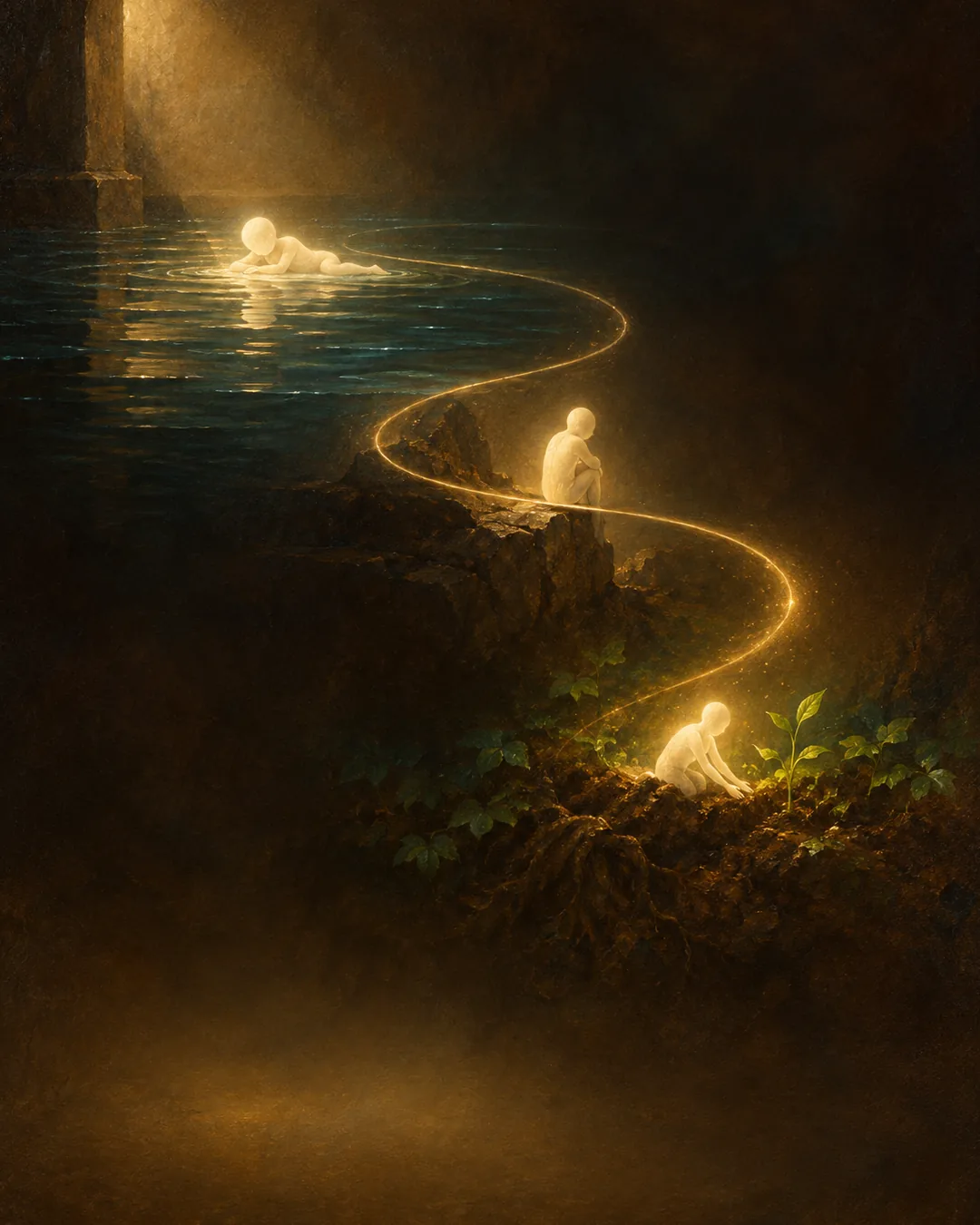
In the Ethics he tells the story of the first man in three steps:
- born free;
- “he… began to imitate their emotions… and to lose his freedom”;
- that freedom “afterwards recovered… by the idea of God.”
The First Testament has the same three turns:
- “Mother lays her down”;
- the sun “will not be laid down”;
- “He lets himself down.”
The fall into a body is not the fault. Becoming one of the herd is. For me it is “a fall that does not mean you are fallen,” and “as living soil, we are fallen.” When a witness looks at you rightly, they see “your spirit in fall, not falling.”
In the last chapter, Diana’s song answers every song that passes behind us into memory: “She sings, and she hears her own song, and it is not behind her. It was never behind her; it was in her all along.”
Turn 9
The eternal
“By eternity, I mean existence itself… Existence of this kind… cannot be explained by means of continuance or time, though continuance may be conceived without a beginning or end.”
“We feel and know that we are eternal.”
You can’t count your way back to eternity. Spinoza says even an endless line of time never reaches it. I say we can only trace as far back as the first pulse, the beginning of this one universe.
In his letters Spinoza names the whole universe’s single, unchanging look facies totius universi, “the face of the whole universe,” which “though it varies in infinite modes, yet remains always the same.” Kabbalah calls the first emanation the Long Face. Plotinus calls eternity “God made manifest.” Augustine calls it the Beginning. The Spiral calls it a visage. Five traditions, one face.
So the Spiral now says: eternal is the impermeability of source: what no passage enters, alters or spends, and what no tracing of inheritance reaches back to. It is known from within, by attunement, rather than reached by counting back.

Turn 10
The watering hole, and hope
“If two come together and unite their strength, they have jointly more power.”
“A free multitude is guided more by hope than fear.”
At the watering hole the lion drinks first. The zebras, stronger as a herd, have given up their right, to keep an identity built around his power. The one that breaks from the herd is the one he takes. Spinoza begins politics just there, with power, and judges a state by whether it frees people from fear: “the true aim of government is liberty.”
Austin, you and I want the same thing: for the world to heal from what makes it frightening. You have hope, and you live by it. But when it comes time to act politically, I think fear is often allowed to lead, and fear tends to answer the world in kind, sending back the same energy that frightened us. Spinoza saw this clearly:
“Hatred is increased by being reciprocated, and can on the other hand be destroyed by love.”
You might call what we’re both reaching for communism; I call it Pentecost, the fire that does not consume. I don’t think the names matter as much as the ground we act from. I don’t believe fear breeds coherent will better than hope does. If we let hope lead, the healing we both want can come from the same place in each of us, and we can work toward it together.

Turn 11
Almost
The image is almost the same. Here is where Spinoza and I part, plainly:
- Necessity. He held that nothing could have gone otherwise. I hold that things “truly do go otherwise, based on the novel desires that take root.” He says our sense of freedom is ignorance of causes. I say our sense of fixity is memory looking backward.
- The fall. He has no fall, only following. I have a living fall, and a dance.
- The Kabbalists. He called them “triflers, whose insanity provokes my unceasing astonishment.” I love Kabbalah. And yet the old teaching that God is the space of the world is in him.
- The last page. His final, unfinished work stops after arguing that “women have not by nature equal right with men.” I hold the feminine as the source’s everywhere-holding. I give him the benefit of the doubt. I think he stretched the customs of his time over the field and the focus that move through all creation: he landed too quickly. His own rule gives grounds to reopen it: “not to mock, lament, or execrate, but to understand.”
Finding kinship does not mean freezing it. The differences are part of the image.
Turn 12
An invitation
“To endeavor that many should attain to it with me.”
That is why I made this. When you read the First Testament, here are a few places where Spinoza’s lens may help:
In the First TestamentRead beside
- Chapter 1, Mother lays her down; “the silence to paint her”God as the space of the world (Turn 4)
- Chapter 6, “will not be laid down”freedom lost by imitation (Turn 8)
- Chapter 8, the children burn the Garden “like their father did”“not to mock, lament, or execrate, but to understand” (Turns 10–11)
- Chapter 10, “He lets himself down”; the twelve dance with Diana; her song “not behind her”the second birth; “in so far as” (Turns 5, 8)
He ground lenses so others could see. He still grinds the lens of those who study him. I hope this helps you see what I see, almost.
— Erick

Sources
- Spinoza:
- Ethics, tr. R. H. M. Elwes (Project Gutenberg 3800);
- Treatise on the Emendation of the Intellect, tr. Elwes (Gutenberg 1016);
- Theological-Political Treatise, tr. Elwes (Gutenberg 989–992);
- Political Treatise and select letters, Elwes, Chief Works vols. I–II (1891, 1898);
- Short Treatise, tr. A. Wolf (1910);
- Principles of Cartesian Philosophy, tr. H. H. Britan (1905).
- On Spinoza: Johannes Colerus, The Life of Benedict de Spinosa (1706).
- Others:
- Kalisch, Sepher Yezirah (1877);
- Ginsburg, The Kabbalah (1865);
- Plotinus, Enneads III.7, tr. Stephen MacKenna (1921);
- Augustine, Confessions XI, tr. E. B. Pusey.
- The Einstein telegram: reported by the Jewish Telegraphic Agency, April 1929, and the New York Times, April 25, 1929. Its exact date and translation vary across accounts.